
Capacity crowds tour region’s largest reclamation plant
29 Oct 2024
Most of Geelong’s sewerage pipes travel to Black Rock, with 70 million litres of wastewater treated daily at the region’s largest water reclamation plant.
All roads also led to the Bellarine facility yesterday, with Barwon Water opening the gates to the 290-hectare precinct for community tours.
The free walking tours saw about 140 people learn how Geelong’s sewerage system has transformed over the past century, and the further advances that lie ahead.
Managing Director Shaun Cumming said the range of initiatives at the precinct provided a great insight into the innovative ways Barwon Water was safeguarding the region’s water sources.
“The evolution of Black Rock is closely tied to the innovative and sustainable technologies we have embraced at Barwon Water,” Mr Cumming said.
“From creating recycled water, to renewable energy and our planned organics network facility, Black Rock is home to so many of our leading and progressive projects.
“Our efforts to maximise resources, build a circular economy and increase recycled water supplies are on full display at Black Rock.”
The site screens out rubbish, and uses micro-organisms to digest the wastewater, to create Class C recycled water.
The wet organic material created by the micro-organisms is collected and dried, before being converted into biosolid pellets, which are then on-sold for use as fertiliser.
In our Class A recycled water facility, we use ultra-filtration, reverse osmosis and UV disinfection to create the highest grade of recycled water.
“Increasing the uptake of recycled water will reduce the reliance on river and groundwater sources, taking the pressure of them as we contend with unpredictable climate and rainfall.”
Alongside the treatment plant, the site is also home to an 8300-plus panel solar farm, which was the first megawatt-scale solar installation in the Australian water industry.
The solar array has played a key role in Barwon Water recently achieving its aim of powering all its facilities with 100 per cent renewable electricity.
Black Rock is also set to host the world leading Regional Renewable Organics Network (RRON).
Planning is progressing for the facility, which will take organic waste (household food, garden, commercial and industrial organics) and safely convert it into high value products.
It will also produce renewable energy, helping to not only reduce emissions but to build the region’s circular economy by diverting waste from landfill.
Barwon Water offers school excursions and tours for community groups at multiple treatment plants and reservoirs across the region.
For more information, please visit www.barwonwater.vic.gov.au/community-and-education/community-groups
BLACK ROCK FAST FACTS
- The largest of Barwon Water’s 11 reclamation plants, treating about 70 million litres of wastewater daily.
- About 130 tonnes of organic material is created daily. It is then dried to produce biosolid pellets, for use as farm fertiliser
- About 28 tonnes of rubbish is removed from the Black Rock sewer every month, reinforcing the need to only flush the 3Ps – Pee, Poo and Paper.
- Hosts a three-megawatt solar farm, comprising 8,388 photovoltaic panels.
- Proposed site of the Regional Renewable Organics Network (RRON) facility, which would convert organic waste into high value products and produce renewable energy.
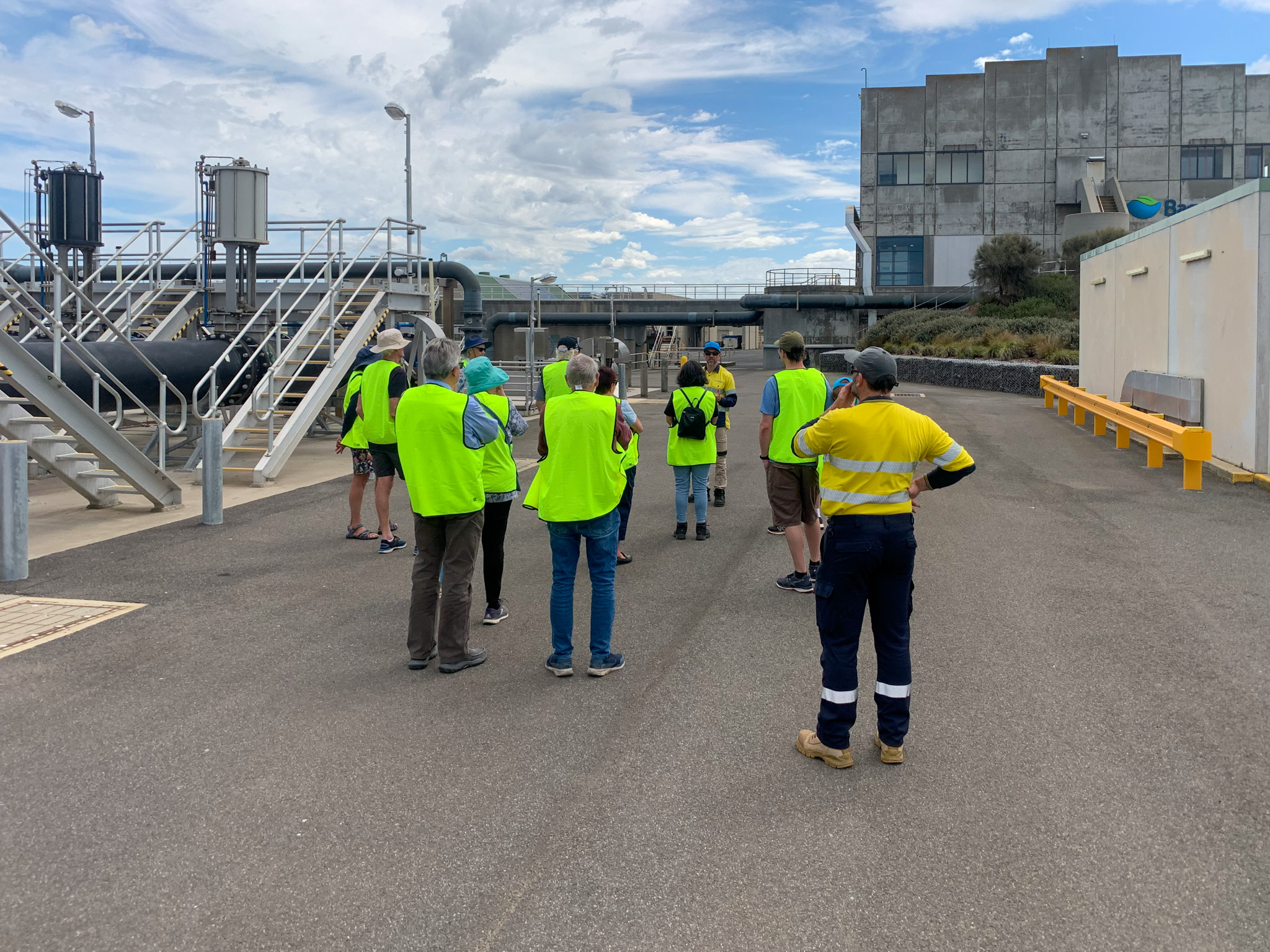
Black Rock Facility Tour Group.